Showing posts with label Media. Show all posts

23/03/2014

The absurd about The Hunger Games

Okay. So, here is what I find utterly absurd about the kind of attention the Hunger Games has gotten, the fandom, et cetera, and why buying Mockingjay-pins made in China is so horribly contradictory.  Here we go.

We, here in the developed countries, are the Capitol. Ever thought about who plucked the fruit you eat? Who sewed your clothes? Who put together your computer? I’ll tell you who: the people in the Districts (aka the developing countries). In that way, one of the multiple issues of our society that the Hunger Games deals with is just that. At least, it is something that I thought of while reading the series, and it made me realise how very wrong it is. Sure enough, one can get a tank top at H&M for virtually nothing, and people are happy because we’re, for some reason, obsessed with money. But have you given any thought to how it can be that cheap? Well, because the workers have to work 13 hours a day, seven days a week, with minimal pay, of course. But hey, who cares? As long as it’s cheap, we’re happy. Except I’m not, because it’s so very wrong.

Let’s get back to the Hunger Games. I don’t think I’ve seen a single fan who doesn’t greatly dislike the Capitol and supports Katniss and those people. Yes, that’s all fine, I do that too, but what is not fine is not realising the connection between Panem and the world we live in today. Because the Hunger Games is not merely an awful story set in the future, but it also contains a shitload of critique toward our current world order, and I think that it’s important that we bring attention to that as well. I don’t think it’s wrong that it has a love-triangle and such elements, because if it wouldn’t, it probably wouldn’t have reached its current fame, but now that it is as famous as it is, it’s very important that we see beyond the love triangle and bring our focus to the actual, real life problems that the series deals with; one of them being how we let people work as slaves while we idly fret, not giving them a single thought. Seeing a label with the texts “Made in China” is so common people don’t even think to think on’t anymore. I can’t say for sure that this is something that Suzanne Collins is trying to tell us in the Hunger Games, but to me it is pretty damn plain and I’m surprised that more people doesn’t seem to see it. So, when buying a Mockingjay-pin that has been produced in China, rather than supporting Katniss, you contribute to the continued oppression of her and all the other people from the Districts. (Well, their contemporary counterparts, anyway.)

“BUT WHAT THE FUCK DO YOU WANT ME TO DO THEN?” you might think. Don’t buy clothes from H&M, for example. Always choose Fair Trade. Buy second hand. Give a fuck about where the things you consume have been produced. Bring attention to this tragic world order. Do everything and anything. At least do something.


But, by all means, continue to buy clothes from District 8 while discussing the amazingly intriguing love-triangle that is, of course, the essential part of the series. (Psst: I’m being sarcastic in this paragraph. Don’t do that. It’s wrong.)

01/02/2014

Marvel stop


I'm only slightly very pissed right now.

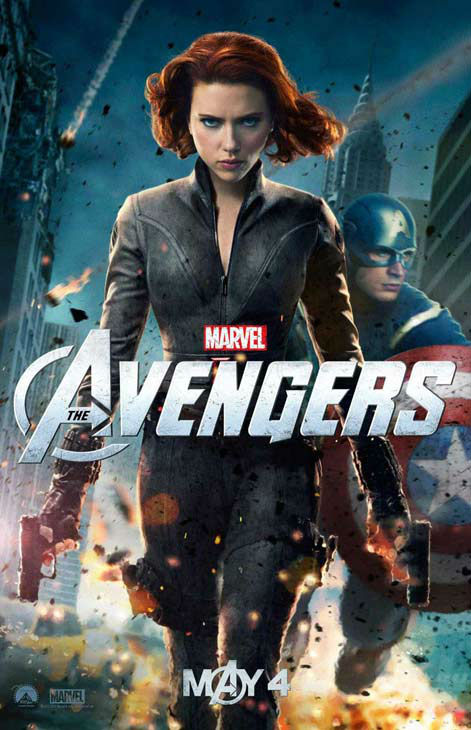
Here's three badass characters, yet only two of them get to actually look real badass, while the third... whips her hair?


What the fuck is up with that
?

Natasha Romanoff is undoubtedly one of the most badass Avengers, yet does she get to look tough and menacing? No, she lookes like she's in a bloody shampoo commercial.

And what really pisses me off is that that's not even true to her character, at least not as she's been portrayed in the films. The Natasha I've gotten to know is tougher than most (tougher than Nick and Steve imo). It's really pleasant to see a female super hero who's only real purpose isn't to walk around and look sexy. Natasha is one of few really cool and well-treated female characters. She's a role model. An actual, good, female role model.

But, of course, we can't have that. In The Winter Soldier, she walks around having romantic relationships with multiple male characters, and of course, she has to walk around whipping her hair seductively.
On the both the Iron Man 2 and the Avengers poster she looked as badass as the male characters. But no, we can't have that anymore.


The only reason I wanted to see The Winter Soldier was because of her. But if this is what she's treated like, I'm not so sure.

04/12/2013

"You CAN'T wear that item like that!"

Welcome to a brand new episode of Things That Bothers Me. This week: people giving too many shits about how other people chose to wear their items of clothing, because this kind of criticism is something that I see far too often. (It might be one of those things that aren't really worth being bothered by, but as it happens, it bothers me, so now I'm going to write a blog entry about it because I want to.)

Far too often I happen to come by people going 'I can't believe people can wear that kind of crop top in this weather!' or, as I actually heard today, 'You can't wear leggings with just a small shirt! Leggings aren't pants!'. These are examples of people giving way too many shits about what other people chose to wear. No, I can't see why someone would wear a crop top with an open jacket when it's winter outside because it must be bloody freezing; neither would I wear leggings with nothing but a small shirt to accompany it, but as it happens, the people wearing it would, and one hopes that the people with crop tops doesn't freeze too much. I myself am not completely estranged to more 'unusual' clothing, actually.

Frankly, what I or you would or wouldn't wear is unimportant when it comes to what other people wear. Because they are neither you nor me, and them wearing whatever they wear doesn't affect either of us more than we let it do. If someone wears something that makes them feel pretty and comfortable (or whatever feeling they're going for), let them. Nothing suits one better than whatever gives one confidence and/or makes one feel comfortable. This might sound like a real cliché, but it's a cliché for a reason. People knocking on other people's confidence even though it's really not their business is just plain sad. Seriously. Don't.

Sadly though, people don't always wear certain items of clothing in certain ways just because they like them. There is, of course, the issue of fashion. I can almost certainly say that some of the people who wear crop tops and leggings don't do it because they want to, but because it happen to be fashion. Possibly, these people (or at least some of them) doesn't feel confident in these clothes at all, which is really sad, since one should wear one feels like. But since one hardly can tell them apart from the confident ones by the same glance that it takes to judge them, skip the judging part. This is a different problem which also needs a different approach; criticising someone's clothes won't help anyone in any case.

So, basically, don't criticise peoples way of dressing even if it doesn't make sense to you, because it doesn't have to make sense to you. Odds are that the person you criticise hasn't dressed in order to please you, anyway.

04/11/2013

Billy Elliot - the Feminist

What follows now is a review of the film Billy Elliot, which I wrote for an English test in class. It is not entirely spoiler-free, but for your leisure, I will mark the paragraphs/sentences which include spoilers with a "*", thereby ensuring your reading to be spoiler free, or at least giving you a choice between spoiler-free and the opposite. That said, allons-y!

Billy Elliot is directed by Stephen Daldry and takes place in the 1980's. The story is about the young boy Billy (Jamie Bell), who lives with his dysfunctional family in a small mining town in Northern England, where the gender roles are strong. We follow Billy through his fight against them as he fights for his right to dance, despite his father Jackie's (Gary Lewis) strong objections.

When it comes to films alike this one, I think the time and place in which it is set is a brilliant choice. Had it, for example, been set in London and present day, it would not at all have been the same kind of film, as the power of the gender roles are not as strong there in the present day.

In the film we follow Billy through a long period of time, so there are some big jumps in the story's time line, which sometimes works nicely but tends to be confusing, in my opinion.

Furthermore, I think that Jamie Bell, who, as previously mentioned, takes on the role of Billy, makes an outstanding performance for being such a young actor, as he is not only needed to act, but also to dance ballet. His amazing performance really enhances the greatness of the film; as does the other actors' brilliant performances.

As I mentioned briefly earlier, it is not merely a beautiful story about a boy who fights for his right to do what he wants, but also a story about the fight against the norm of what is typically male/female and, in Billy's (and his friend's Michael's) case, working against them. This is portrayed beautifully in a boy who really is not trying to fight them at all, but simply wants to do what he loves to do, and in that way he, more or less subconsciously, makes a stand about his and other people's rights and brakes the norm without even really intending to. *In the meantime, one can notice how his character changes and he becomes more and more confident as the story progresses; from hiding his ballet shoes from his father, to take a stand and simply dance in front of him.

*When it comes to character development, I think that the greatest one seen in the film comes from Billy's father Jackie, which makes a beautiful kind of side-story (which is strongly entwined with the main story), as he transforms from a grumpy, distant father who wants Billy to follow the male norm, to a warmer father who is even prepared to give up his moral and take up his mining job, just in order to support Billy. Characters like Jackie are often what makes great works of fiction as great as they are.

The film shows a beautiful story about the life of a devoted young boy, at the same time as it is a great representation of the society and the norms it is built around, and also displays a fairly large quantity of inspirational characters, which all in all makes it a film truly worth watching and reflecting about.

I feel as though there are a ton of other aspects I could bring into the review, lots of characters and their developments to write even longer paragraphs about, but I feel as though I have now bored you for long enough.

19/10/2013

How to write "strong", female characters

There are probably plenty of aspiring writers out there in cyberspace, and being an aspiring writer, one can probably use with a couple of nice tips. Therefore, I have completed this list of tips (or, if you wish your piece to be famous, rules) about how to write strong, female characters. Enjoy!
  1. Make sure she is rather bad-ass, except when it comes to that one guy (aka the hero*), who makes her change completely, so that suddenly she is oh so weak. It is also important that this guy makes her lose all her bad-assness like *that*. The guy does not necessarily need to have as passionate, or even any at all, feelings for her; in fact, it makes him cooler if he does not.
  2. Do not give her a proper personality. She only needs to consist of her bad-assness and passionate love for the hero.
  3. This bad-assness must consist of at least 90% sexiness. Ergo, her only power must be to be able to flirt with various male characters (I mean, her flirting with a female would imply some sort of bi-, pan- or homosexuality and that is something we simply can not have).
  4. The previous point implies that, naturally, she has to follow media's idea about what "being sexy" means.
  5. Whenever she has a conversation with another female, it has to be about one/some of the male character/-s.
  6. She must not do anything for her own sake. Remember, it is all about the hero.
  7. Giving her a name is not a high priority. The hero could always simply call her "babe", "sexy" and so forth.
  8. If you do give her a name, at least make her the only female character with a name.
  9. She has to be naked at least once (preferably more than once though).
  10. When she is not naked, make sure her clothes are revealing (as oppose to the hero, who should be properly dressed at all times).
*Note about the hero: Make sure that the hero is a male. A female hero would completely brake the norm and it just would not be sane (again, remember what I wrote about bi-, pan- and homosexuality).

There are, of course, plenty of other things (/rules) to have in mind when writing strong, female characters, but I hope that this small guide helped you in some measure. Good luck with your writing!

This sarcastic entry has been brought to you by Hedda, aka panphobic.